Dumbbell Deadlift
A compound hip-hinge exercise performed with two dumbbells.
- Body part
- Legs: all exercises
- Movement
- Hinge: all exercises
- Equipment
- Dumbbell: all exercises
What it trains
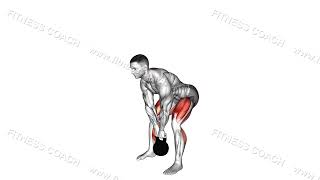
- Biceps Femoris, Primary, 85%
- Gluteus Maximus, Primary, 85%
- Erector Spinae, Secondary, 50%
- Semitendinosus, Secondary, 50%
- Semimembranosus, Secondary, 50%
- Upper Abs, Stabilizer, 25%
How to perform
Stand with your feet hip-width apart and place a pair of dumbbells on the floor in front of you.
Bend at your hips and knees to lower your body and grasp the dumbbells with an overhand grip.
Keep your back straight, chest up, and shoulders back as you engage your core.
Drive through your heels to lift the dumbbells by extending your hips and knees to stand up straight.
At the top of the movement, ensure your body is fully upright with shoulders back and chest open.
Lower the dumbbells back to the ground by pushing your hips back and bending your knees, keeping the spine neutral.
Repeat for the desired number of repetitions.
Tips
Focus on keeping your spine neutral throughout the movement to avoid injury.
Engage your core muscles to stabilize your body as you lift.
Ensure that the movement is initiated by hinging at the hips rather than bending at the waist.
Keep the dumbbells close to your body as you lift and lower them to maintain balance and control.
Avoid rounding your back; maintain a flat back position during both lifting and lowering phases.
Use a mirror or ask for feedback to ensure proper form, especially if you're new to this exercise.
Start with lighter weights to master technique before progressing to heavier loads.
Common mistakes
Rounding the lower back or losing a neutral spine while lifting or lowering the dumbbells.
Turning the lift into a squat by bending the knees too early instead of sending the hips back.
About this exercise
It develops the glutes, hamstrings, and spinal erectors through a free-weight deadlift pattern. Because each hand holds its own weight, the dumbbells can travel close to the legs and the starting height is easy to adjust, which makes it a common way to learn the hinge before a barbell deadlift.
Related exercises
Alternatives · 1
Ratings & reviews
Questions & answers
Loading…